
Painting as a tool
Gestation, life force and the value of the sensory
Contemporary culture prioritises the visual - the ‘ideal’ body only needs to look like it is experiencing, doing, able and healthy. It is mostly shown on screens where the smooth, dry, glow dominates the wet realities of lived experience.
Our increasing reliance on the scrolling, frictionless, accommodating world of technology and its effect on our expectations of bodies leads me to ask how we cherish our leaky, faulty ‘wetware’ humanity in such a situation? (‘Wetware’ coined by Rudy Rucker, 1988).
What value does painting produce as a bodily practice, and how can this challenge contemporary cultural ideals of the female body?
Sensuality, vitality and acts of nurture are recurrent themes in my work, reflecting my interest in searching for lushness and cherishing of the human body and experience. I paint on absorbent and repellent materials with fluid media to evoke tactile bodily sensations. Saturating wet fabric with inks and squishing paint over aluminium conveys the movement and fluidity of the internal and external body. The two surfaces I am most drawn to working with cohere well with the dualities of modern life - the soft, absorbent velvet and the shiny, impenetrable aluminium.
I’d argue that painting is not just an act of expression, but a gestational process that mirrors and emphasises the value of the watery body - in particular the labour of the female body - and the value of embodied encounter.
2nd March 2026: I had an exhilarating dream - I had discovered a new life form. It was painting.
There is an inherently satisfying pleasure in making, and I therefore argue that the practice of painting has a vital role in reclaiming an embodied, spiritual and erotic power for the artist.
Merleau-Ponty argues that the body is the ground of all knowledge, that it is impossible to separate conscious and subconscious perception, and that making is inseparable from feeling (Merleau-Ponty, 2012).
Despite having filmed myself and my body in both public and private performance as research and source material, in the studio my body is no longer seen but only felt and I remember another way to judge its value. My body is my practice, the start and end point for my paintings, which depict my and others’ bodies as the site of experience. As my body performs actions, according to a process that does not wholly involve my intellectual brain, I witness mind-body connection in real time.
My current body of work began with observing and painting my pre and post-natal body, and my babies. It progressed to filming myself performing, where the act felt more like personal exploration, but the selection and painting of stills quickly became about exploring and performing female ideals.
Examples shown chronologically below.
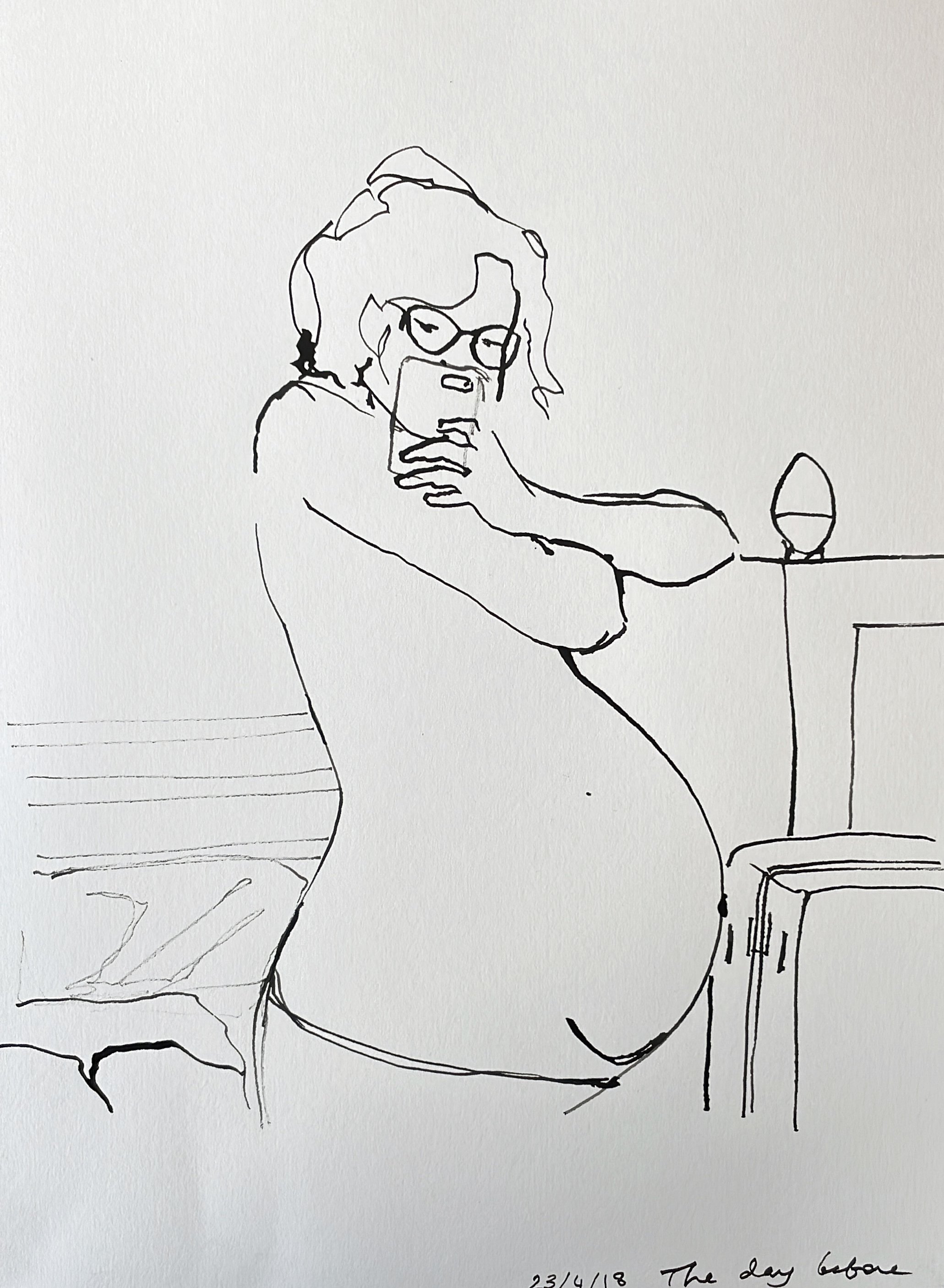
Rose Fulbright, The Day Before, 2024, Ink on Paper, 59.4 x 42cm
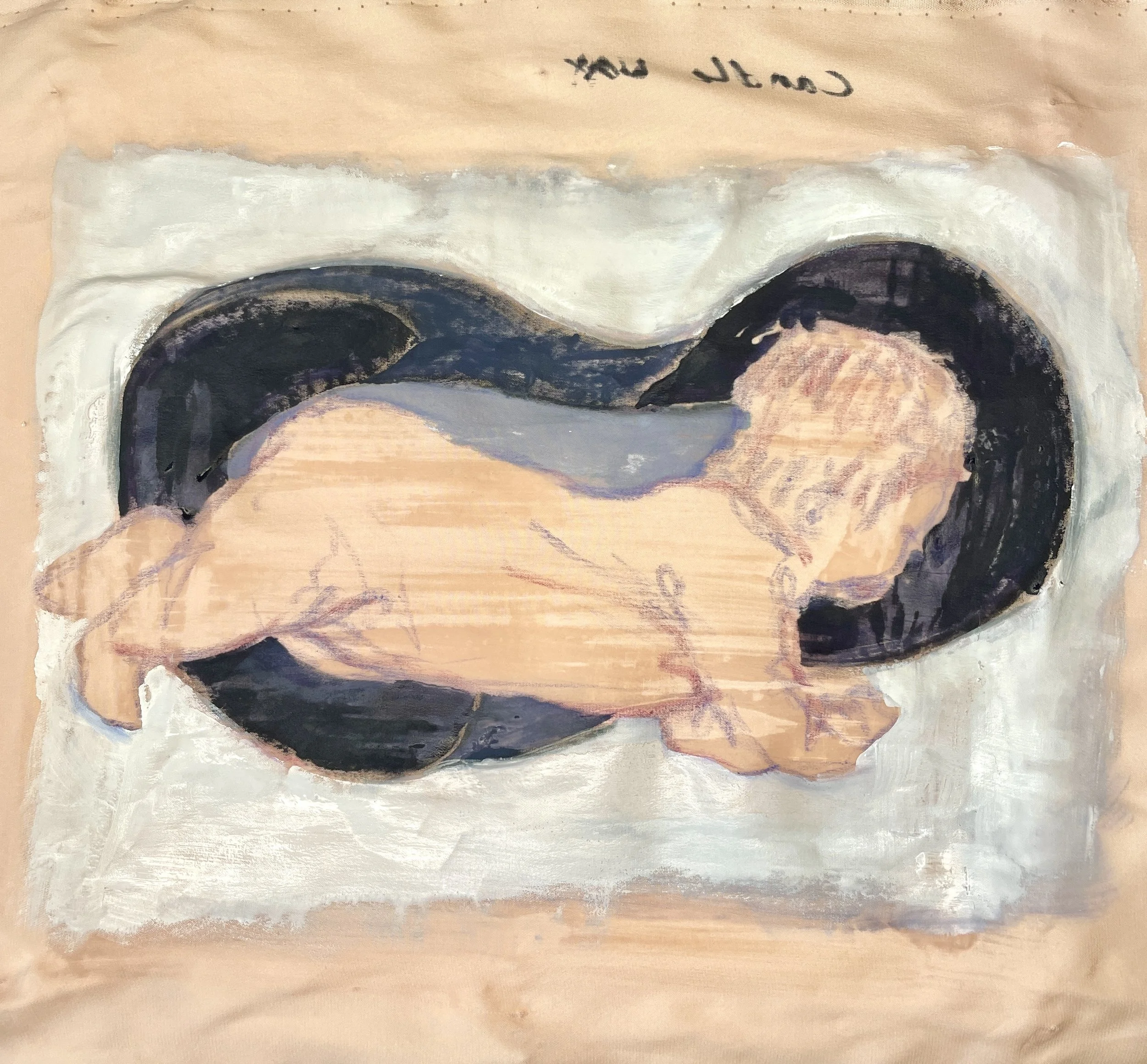
Rose Fulbright, Sleeping Baby, 2024, Oil on silk satin, 32 x 49cm

Rose Fulbright, A Question of Presence, 2025, Acrylic on canvas board with beeswax, 40cm diameter
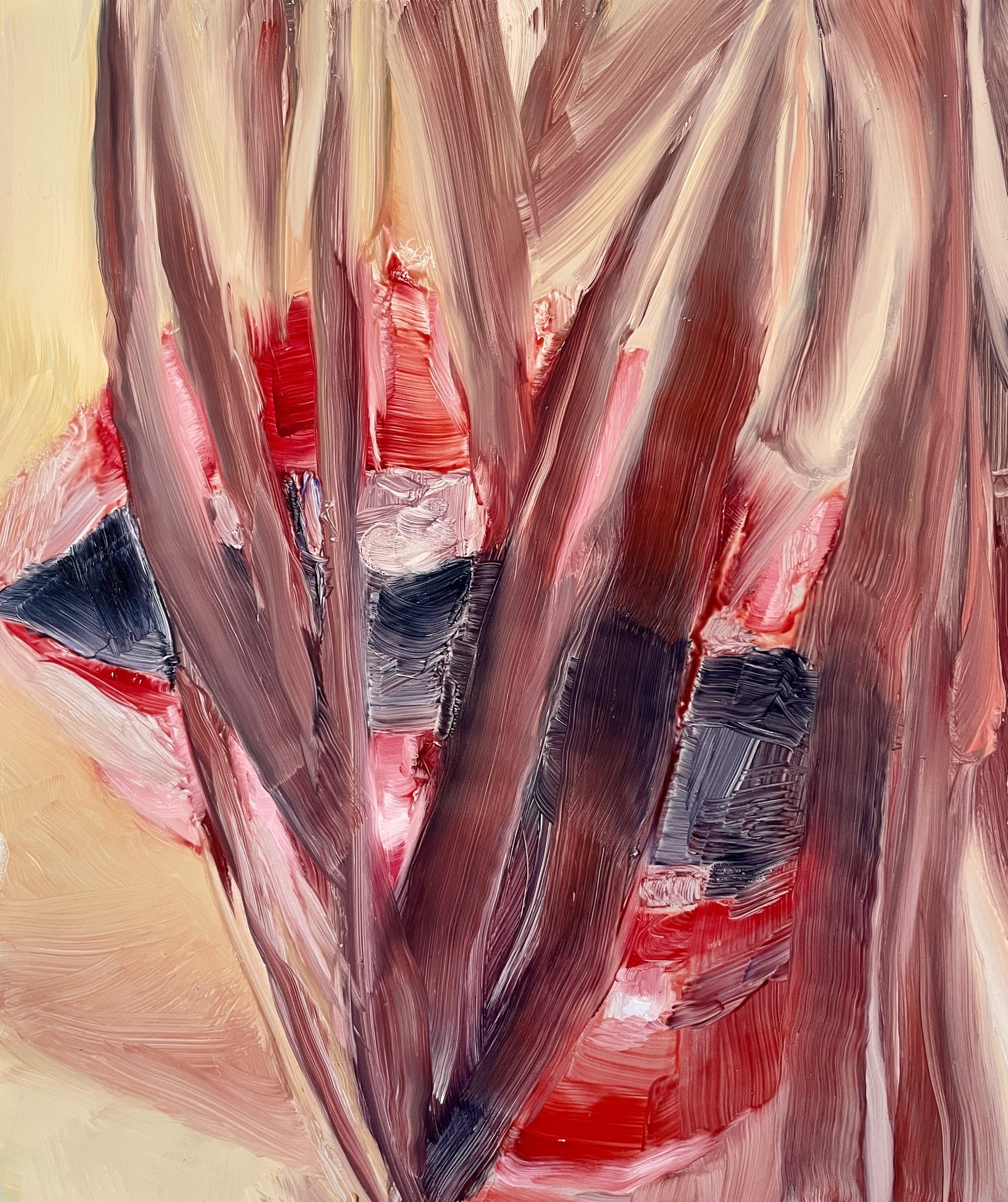
Rose Fulbright, Lips, Teeth, Tongue, 2025, Oil on aluminium, 30.5 x 25.5cm
This project has been a continuous search for the threads that bring my body - what it can sense, do and potentially be - together in a visual representation that mirrors its value back to me and others.
I contain creation. Not only through my art practice, but I have twice grown kicking, screaming new life inside my body. I know that ‘I’ is the place where life happens.
Considering the painting body, I challenge the act of painting’s comparison to the act of sex - which has been made by many artists. The legend goes that an inspiration or urge leads to a physical outburst of passion and/or vulnerability, and results in creation. So simple, so quick, so dominant and imposed, so momentary.
[…] the theological analogy between God and painter credits the latter with producing the impression that his or her pictures are animated, a creative capacity in the strict sense that’s in turn directly related to the issue of value.
(Graw, 2018, p.50)
Graw’s writing does not consider the process of biological female gestation as the original precursor to the “Godly” ability to create life, which is a loophole worth exploring.
I propose that the act of painting is more comparable to gestation.
Sex is the initial thought, the starting gun, and yes, there is something physical that urges itself out of the body, but for me, painting is so much more than just one, heightened moment.
Gestation is the physical effort, productive energy, endurance, nurturing collaboration and life force that must come through the mother/painter and her ‘material’ in order to bring something new into the world. If the painting is properly attended to, it, like the fetus, manages what must happen next - where the next limb bud must be grown, the next mark made. For the artist/mother, there is an innate unknowability of outcome, requiring faith in the uncontrollable.
During every health issue I’ve had, but mostly when I was experiencing infertility and undergoing IVF, I felt incredible frustration in my desire to control the outcome, which was of course impossible. This connection with fertility, control and painting comes through in my work. The soft lushness of the cotton velvet surface reminds me of my thoughts about my womb when trying to conceive. At peak fertility, the womb is lined with red blood cells that create what I imagine to be a sort of absolutely plush, deep silk velvet carpet for a newly fertilised egg to dive into and secure itself safely within.
I continue to chase this utterly desirable peak of human ripeness in my work, for what is life for, but to create and nurture new life, in whatever form one wishes?
BibliographyLorde, A. (2019) Sister outsider. New York: Penguin Books.
Merleau-Ponty, M. (2006) Phenomenology of perception: an introduction. London: Routledge.Graw, I. (2018) The love of painting: genealogy of a success medium. Berlin: Sternberg Press.Rucker, R. (1988) Wetware. New York: Avon Books.