
The Unbounded Body
Wetness and excess
It is my assertion that the most powerful sensorial experiences specific to the female body (sex, gestation and birth) are culturally suppressed because they are wet, excessive, and uncontrollable. Second wave feminist artists including Hannah Wilke, Carolee Schneemann and Helen Chadwick directly challenged this repression, without fully dismantling it.
Philosopher Astrida Neimanis’ theory of Hydrofeminism is that if we can accept ourselves as bodies mostly made of water, we are connected through history and fluids to each other and the whole earth. The goal of this philosophy is to highlight our responsibilities to our earth and each other as one being. Neimanis uses water to amplify the unknowability of our complex and tangled existence.
[…] a body of water - ebbing, fluvial, dripping, coursing, traversing time and space, pooling as both matter and meaning […] Water entangles our bodies in relations of gift, debt, theft, complicity, differentiation, relation.
(Neimanis, 2013, p.85)
This multiplicity is also central to Luce Irigaray’s philosophy, referring to the female in particular as unbounded, not fixed. Elizabeth Grosz summarises: “Irigaray accepts the phallocentric image of woman as ‘not one’ but reverses its meaning: if woman is ‘not one’, she is more than one.” (Grosz, 1989, p.118).
It is this being made of water and the female’s potential to create new life from and morph through water, that makes us “more than one”. This multiplicity is not only a state of being - it is a source of pleasure and experience, and therefore knowledge. Where sensuality has historically signalled physical indulgence at the expense of thought, my practice insists on the opposite. The fact of the female body’s complicated biology results in many potential phases and sensations (multiple orgasms, menstruation, pregnancy, breast-feeding, menopause) leading to my assertion that the female body, in particular, is a powerful site of knowledge.
“The very word erotic comes from the Greek word eros, the personification of love in all its aspects - born of Chaos, and personifying creative power and harmony. When I speak of the erotic, then, I speak of it as an assertion of the lifeforce of women; of that creative energy empowered […]”
Lorde, 2019, p.49
Lorde’s assertion is that this erotic, this pleasure in sensation of any kind, is a kind of feminine spiritual knowledge rooted in the body. This is in direct opposition to the pornographic, which is rooted in gaze and ‘plasticized sensation’ (Lorde, 2019, p.44).
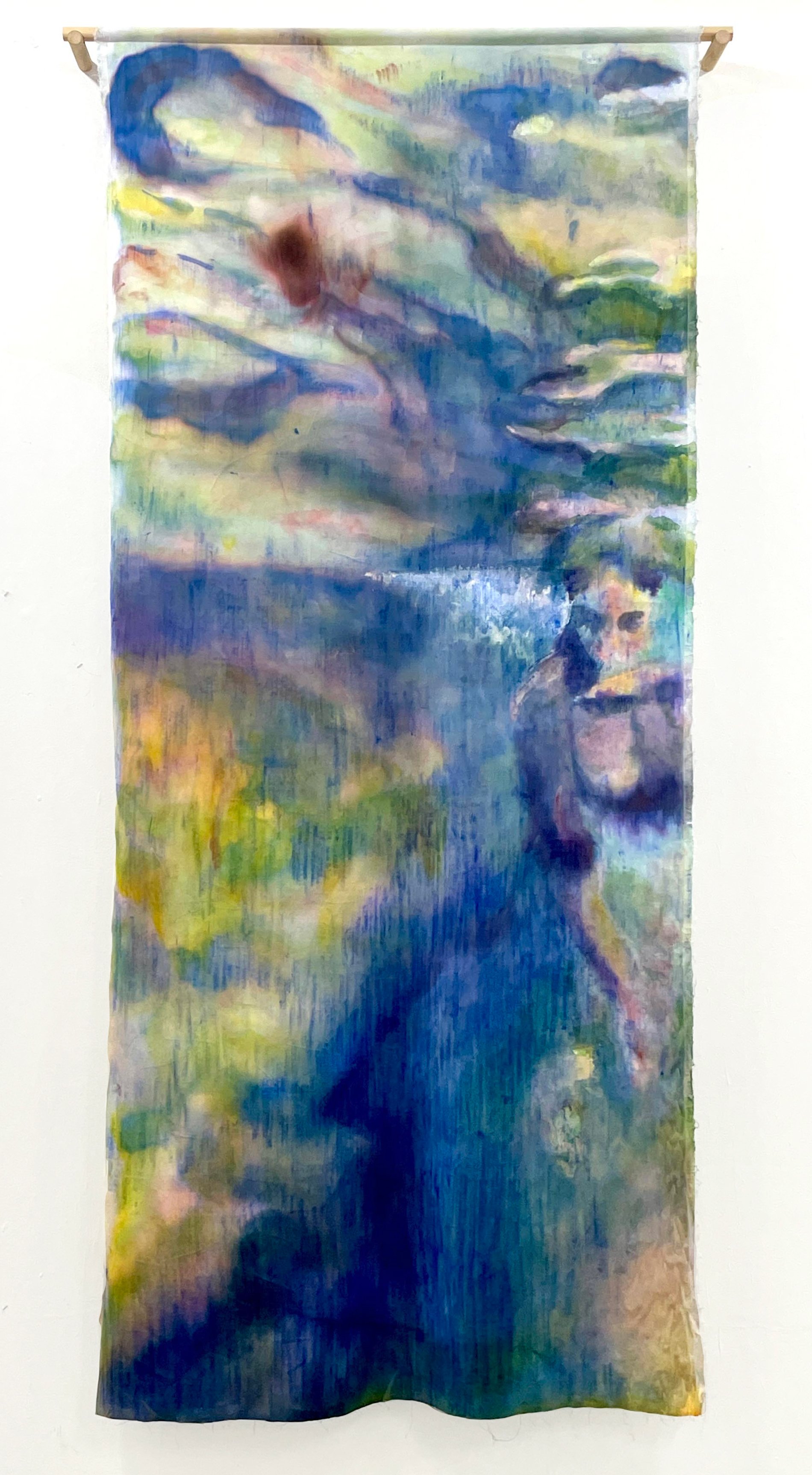
Rose Fulbright, Get a Grip, acrylic and oil stick on cotton velvet, wooden pole. 210cm x 110cm
Sensation is vital to my work in subject matter, physical making, and the sensorial experience of the viewer. I believe that for a viewer, a painting in velvet - the saturation, lines and stains where it has pooled and bled, the way it absorbs and yet reflects light - offers the possibility of feeling inside the work.
Neimanis’ main argument is that phallogocentric cultural control - phallogocentric meaning a culture that prioritises the masculine viewpoint and the phallus as the central symbol of power - prioritises an individualised approach to bodies, alienating us from each other and the multiplicity of our female selves.
Dryness is linked psychologically to a rejection of the possibility of death, because an acceptance of the fluid body is an acceptance of materiality, subject to disintegration (Grosz, 1989). Is the ideal of dryness, which actually means death for humans, appealing because it allows us not to think of death?
Julia Kristeva’s theory of the abject as told by Barbara Creed, relates to this rejection of our innate fluidity. The abject threatens our civilised notions of ourselves, and must be completely excluded from the body (Creed, 2014, p.223). At the same time, we are fascinated and disgusted by it, using it to remind us of our civilisation.
[…] an encounter with abject things (bodily wastes, death, the corpse, cannibalism, animals) effect a renewal of the individual’s sense of self and civilisation […] thus, the subject is constantly drawn to the abject, the abyss, which fascinates but which must be repelled for fear of self-annihilation.
(Creed, 2014, p.225)
The average pre-menopausal adult female body is constantly in touch with the abject - menstruation, the wetness of sexual pleasure and sex, and if reproducing, the oozing and bloating of pregnancy, birth and all its many excretions, post natal leaking and lactation. This body is constantly losing fluids throughout her fertile life, a regular reminder of her animal and abject nature. (Grosz, 1989, p.79) This is actively repressed in Western culture - from the ‘hygenic’ blue dye used in period pad adverts to the careful cropping of birth scenes in cinema.
Visible pregnancy and birth are often treated with unease in Western culture, imagined simultaneously as natural and grotesque. Popular comparisons to films such as Alien reveal and promote anxieties surrounding the pregnant body as excessive, hormonal and uncontrollable. The Hollywood film birth includes much screaming and sweaty faces, but to witness birth as it actually is (in my experience) slow, aching, a strange kind of disembodied-embodiedness, release, confusion, extremely fluid, we would have to acknowledge where we come from, that place of abjection in which we existed before we became civilised and separate (Kristeva, 1982, p10).
My work is thoroughly maternal in that it accepts and presents the freedom to be many things. I would argue that through the Trojan horse of aesthetic beauty, while also caring for the pleasure of the viewer’s experience, I am using what this culture values to send my message
This message is of the power and agency found in the loving acceptance of the untidy and unbound human - the living, sensing and generative potential in being a valuable female body.
Bibliography
Creed, B. (2014) The Elephant’s Graveyard: Spectres of the Abyss? Art in the Global Present, 2, pp.216–40. DOI: http://www.jstor.org/stable/j.ctv1w36pfr.21
Kristeva, J. (1982) Powers of horror : an essay on abjection. Translated by Roudiez, L.S. New York, Columbia University Press.
Neimanis, A. (2013) Hydrofeminism: or, on becoming a body of water. In: Gunkel, H., et al. (eds.) Undutiful daughters: new directions in feminist thought and practice. New York: Palgrave Macmillan, pp.85-99.
Grosz, E. (1989) Sexual subversions: three French feminists. Sydney: Allen & Unwin.
Lorde, A. (2019) Sister outsider. New York: Penguin Books.